
 +86 18402183495 +86 18402183495

NewsNews Center
In advance of the IAA Transport 2026, Germany, ZF held a Technology Day at a test site near Hannover to showcase its latest innovations in safety and motion control systems.g. These technologies will help customers create cleaner, safer, smarter and more efficient commercial vehicles, laying the foundation for software-defined vehicles and AI-driven future vehicle architectures while improving current operational efficiency.
In view of the different transformation progress speeds in different markets, ZF emphasizes providing the maximum flexibility for customers, adopting progressive technology path and continuous iterative upgrading through scalable platform, flexible electronic and electrical architecture, intelligent system and digital ecology, so that vehicle manufacturers and fleet operators can improve vehicle safety and operation efficiency, reduce vehicle total life cycle cost (TCO) and ensure the long-term value of existing investment.
"The direction of commercial vehicle development has become increasingly clear, but the realization path is nonlinear and requires iterative propulsion. In this Commercial Vehicle Technology Day, we show how to create value for our customers through practical solutions to drive the industry toward a 'zero accident' and 'zero emission' future in a cost effective and scalable manner."
In response to the growing complexity of commercial vehicles, ZF is moving towards software-defined architectures that transform vehicles into platforms for sustainable upgrades. The target-oriented E&E architecture and software enable the vehicle to continuously improve performance over the lifecycle, such as increased awareness, optimized energy consumption, predictive maintenance, and increased attendance. This method supports the vehicle factory to introduce new functions through software while minimizing hardware changes.
"Intelligence of software and connected systems is becoming the key to unlocking the potential of commercial vehicles. ZF's development path for software and function driven commercial vehicles is progressive. We combine our expertise in ADAS, braking, electric drive, steering and suspension systems with electrical and electronic and software architectures to enable continuous optimization of the vehicle throughout its lifecycle."
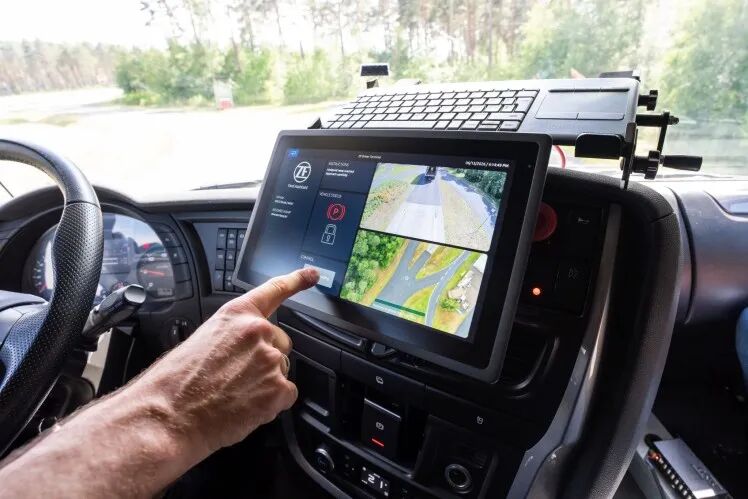
ZF demonstrates the evolution of commercial vehicle safety from a single assistance function to a system-level solution. Scalable sensing system built from radar and cameras, deployed around trucks and trailers, providing 360 ° continuous environmental awareness without blind spots. ADAS、 The brake system and steering system work together to form an integrated safety ecology and help realize the long-term goal of "zero accident".
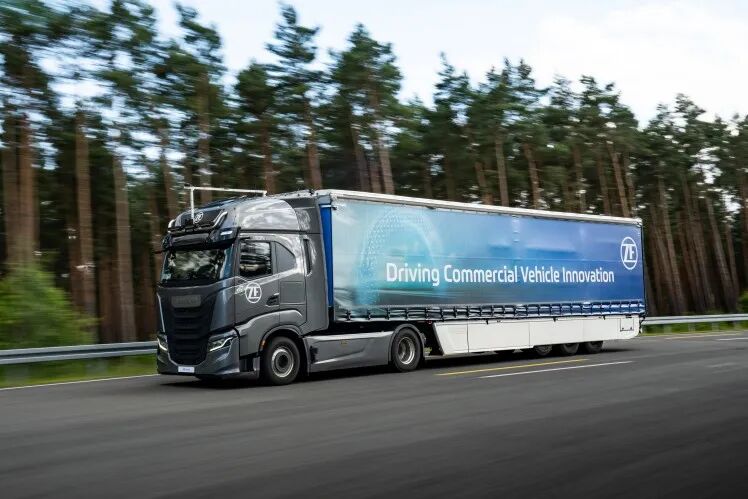
ZF's next-generation ADAS further improves the system scalability through Truck-Trailer-Link and distributed architecture, and lays a foundation for achieving higher levels of autonomous driving. It is not limited to the truck itself: the integrated trailer solution includes a trailer camera monitoring system, which allows the view coverage of the main trailer and supports safer handling and steering. The advanced reverse assist system can recognize the obstacles behind the trailer and trigger the brake, thus reducing the risk of collision in the park and during loading and unloading operations.
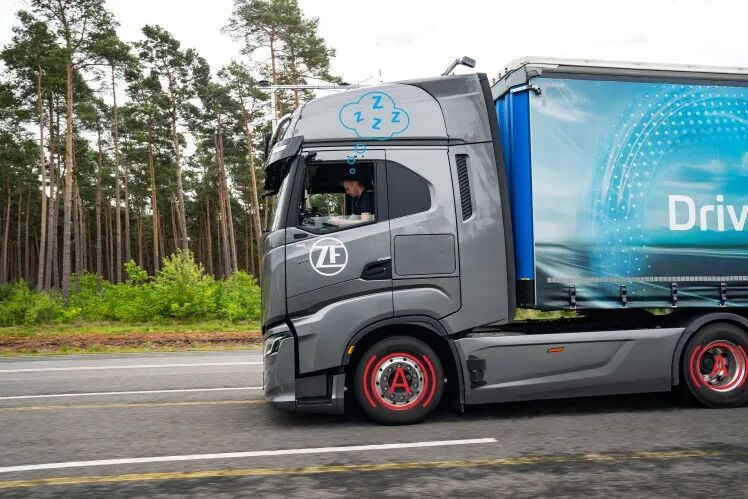
Driver monitoring system
The Driver Monitoring System can identify distractions or fatigue and provide real-time warning to reduce human caused traffic accidents and comply with the latest European General Safety Regulations (GSR). At low speeds, the warning and active brake assist functions at near corner and starting provide better protection for vulnerable road users.  . In addition, rescue assist can identify emergency vehicles in advance through acoustic alarm recognition technology.
ZF also demonstrated a number of innovative technologies for urban public transport: the City Bus CMS uses targeted braking strategies to mitigate collisions while protecting standing passengers; City Bus Assist, based on sensing sensors, supports precise docking through auxiliary steering and kerb height recognition, improves uptime and reduces vehicle and infrastructure losses; In conjunction with the electronically controlled air suspension control system (OptiRide ECAS), it also offers intelligent kneeling, making it easier for passengers to get on and off the vehicle.
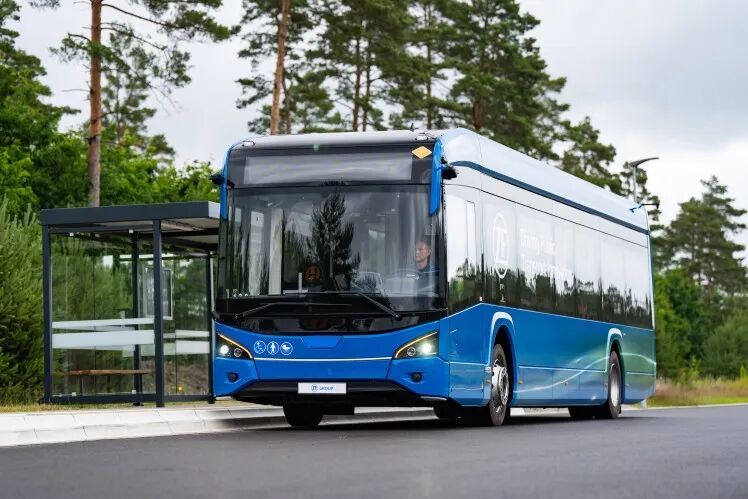
Urban public transit auxiliary system
Continuous Damping Control Damping System CDC ® Skyhook uses a software-based damping algorithm to improve vehicle stability and ride comfort by adjusting the damping characteristics in real time. The system automatically adjusts according to the input of multiple external sensors and CAN signals, which is conducive to the stable operation of the vehicle in a complex urban environment.
ZF believes that there is no single solution for commercial vehicle electrification in the face of diversified application scenarios, and the transition to zero emission transportation must be practical, scalable and economically feasible. ZF provides a modular technology portfolio from hybrid to electric drive, supporting vehicle manufacturers to realize electrification transformation of existing platforms with minimum changes and maximum flexibility, helping fleet increase efficiency and reduce TCO.
As a hybrid solution, the TraXon 2 Hybrid Transmission 2 adopts P2 technical route, which is applicable to all-hybrid and plug-in hybrid vehicles. It supports pure electric starting, energy recovery and flexible mode driving. It is a transitional solution considering performance, reliability, energy conservation and emission reduction effects and provides support for the development of motorized transportation in the next decade.
ZF modular electric drive solutions include central electric drive system CeTrax 2 series and electric drive axle AxTrax 2 series. ZF's electric drive axle solution also supports motorization of the trailer and assists traction, improves efficiency and reduces emissions through energy recovery. AxTrax 2 electric drive bridge will also be mass produced in ZF Jiaxing.
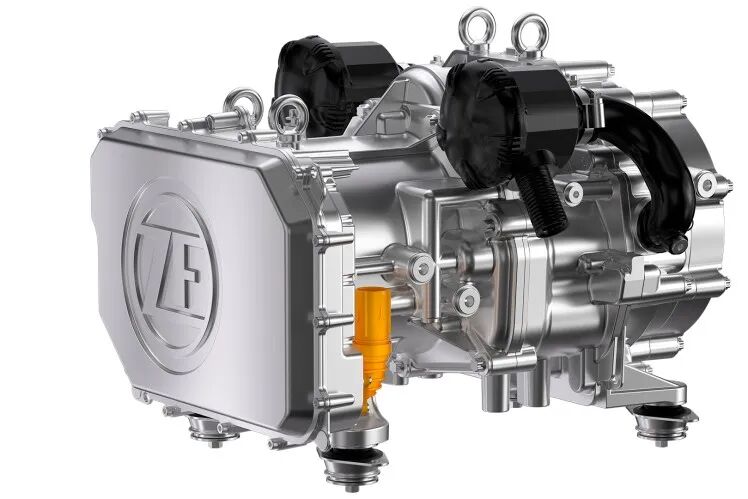
E ‑ comp Scroll Oilless Scroll Electric Air Compressor
ZF also expands electrification from drive system to auxiliary system field, such as e-comp Scroll oil-free scroll electric air compressor. Compressed air is essential for key functions such as electric vehicle braking and suspension, and as a transitional solution, this product features low noise and high energy efficiency to meet more stringent noise regulatory requirements in the future.g. At the same time, its oil-free design requires no lubricating oil, which can improve the quality of compressed air, avoid the performance degradation of system components due to long-term operation, and effectively prevent the lubricating oil from polluting the environment.
ZF emphasizes that the intelligence of software and system integration is the basis of commercial vehicle innovation. Vehicle architecture is evolving from signal-driven to service-oriented to enable scalable vehicle route coordination, on-demand functional deployment, and automatic configuration of specific scenarios to support an integrated logistics ecosystem. New functions can be realized only by software upgrading on the existing hardware platform.
ZF's demonstrated solutions include main data connectivity, park automatic configuration, emergency braking based on low-power Bluetooth (BLE) signals, and remote vehicle access, including OnHand ™ Interaction between vehicle safety systems such as electronic parking system (EPH).
The intelligent trailer technology further opens up the park, loading and unloading wharf and road transportation links to realize seamless connection of the whole process. The trailer control and auxiliary docking platform in the cab and other functions improve the operation efficiency of the complete vehicle and the intelligent level of the system.
Commercial vehicles are accelerating their integration into the interconnected operational ecosystem. The improvement of efficiency, attendance and safety brought by software and system intelligence has broken through traditional driving scenes. ZF's existing technology has been able to be deeply integrated and interoperable with a service-oriented architecture and can be immediately applied to optimise freight and passenger performance.

+86 18402183495

+86 18402183495

sales02@shanghai-longti.com
sales01@shanghai-longti.com
Follow us

About Us
Brand
News
